
Plant City Directory Collections
Research starts with a set of verified holdings, not an assumed annual run. Federal historic-district documentation identifies a standalone Miller volume. The Plant City Photo Archives and History Center reports Polk editions from various years, plus local cemetery books and family and business papers. The State Library of Florida holds directories arranged by place and year. Its catalog and reference staff are the best way to check whether a specific volume is available before traveling.
| Collection | Years | Where Held | Access |
|---|---|---|---|
| Miller's Plant City volume | 1937-1938 verified | State Library catalog and NPS citation | Catalog and on-site inquiry |
| Polk directories | Various years, 1955-2000 | Plant City Photo Archives History Center | Appointment and reading room; fees may apply |
| Florida directory shelf | Early 1900s to present statewide span | State Library of Florida | On-site or reference request |
| Federal census schedules | Through 1950 publicly released | NARA and library genealogy databases | Free NARA or library access |
The phrase “various years” matters. It does not promise one book for every year from 1955 through 2000. Ask staff to confirm the exact title, year, publisher, and geographic coverage. A volume may be a Plant City standalone book, a Polk multi-community edition, a Tampa or Hillsborough volume with a Plant City section, or a telephone directory. Photograph the title page and coverage statement before using an entry as evidence.
Plant City Directory Repositories
The local route begins with the Plant City Photo Archives and History Center. Its collection includes more than 100,000 photographs, negatives, and documents, along with Polk volumes, cemetery directories, maps, letters, diaries, clippings, and business records. Research appointments have been offered at 813-754-1578, Tuesday through Friday from 8 a.m. to 5 p.m. Requests may take one to two weeks, and fees may apply. The organization reported a move to the Lee Building in 2026, while an older page still showed 106 S. Evers Street, so confirm the location before a visit.
Bruton Memorial Library can help search the local catalog and licensed genealogy resources. For deeper county material, the Florida History and Genealogy collection at Tampa's John F. Germany Public Library is the regional hub. The State Library reference desk, 850-245-6682, can check its catalog by place and year. These channels complement one another: the History Center is strongest for hyper-local material, while the library system and state collection extend the shelf.
Search Plant City Directory Catalogs
The State Library's directory collection page explains how the statewide shelf is arranged and how to ask for a particular place and year.
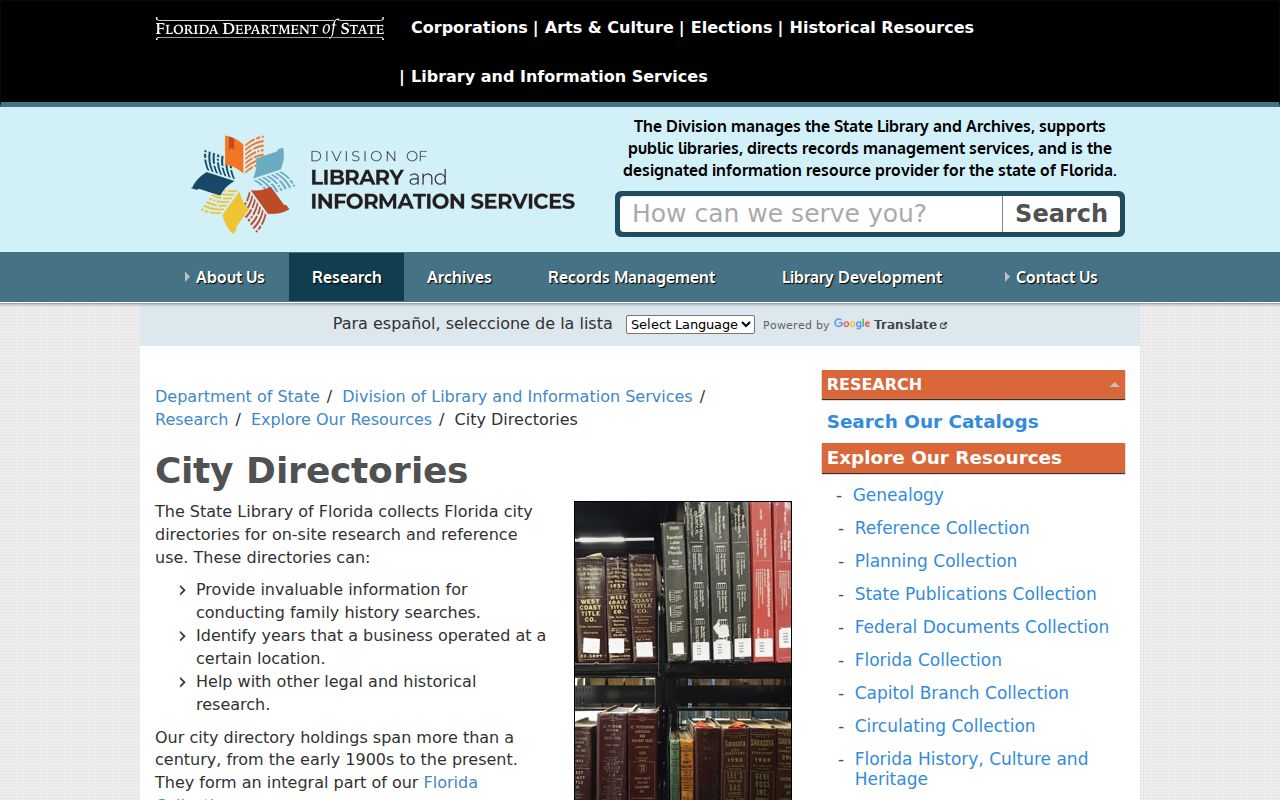
The catalog view is a starting point, not proof that every year survives or has been digitized. Give reference staff the city, approximate year, and any publisher or title found in another citation.
Plant City's Two History Desks
Plant City's research network grew from local effort. The Woman's Club began a volunteer library in 1927, and voters approved a tax-supported library in 1959. Bruton Memorial Library now serves the city through the county cooperative system. The Photo Archives developed as a separate local repository focused on the city's images, papers, maps, and directories.
That split is useful. A catalog search may identify a title, while archival staff may find a photograph, clipping, cemetery entry, or family file that explains the person behind it. Railroad and strawberry-industry records are especially relevant because both shaped Plant City's growth. Ask each desk a precise question and keep a note of which collection supplied each fact.
Reading Plant City Directory Entries
A historical entry is compressed. Read it with the abbreviation key from the same volume. Typical Miller and Polk fields can include the surname and given name, spouse in parentheses, occupation, employer, residence, business address, and a widow notation. Some books mark a homeowner or renter. Because no accessible digitized Plant City page was available for direct inspection, these are typical fields to check, not a claim that every local edition prints all of them.
| Personal name | Surname, given name or initials, sometimes with a spouse in parentheses |
|---|---|
| Work line | Occupation and, in some editions, employer or business address |
| Residence line | House number and street, or an older rural route and box |
| Tenure mark | A symbol may distinguish a householder, owner, renter, or boarder |
| Family clue | Spouse, widow notation, or a removal note can link editions |
- Criss-cross directory
- A reverse section arranged by street and house number rather than surname.
- Householder index
- A list centered on the person identified as the primary householder, not every person in the home.
- Abbreviation key
- The volume's own legend for short forms and symbols. Save it before interpreting an entry.
Initials and compound surnames can hide a match. Search both spouses, alternate surname order, and nearby entries. A listed adult is not a full household census, and an omitted name does not prove the person was absent.
Reverse Plant City Address Searches
Alphabetical and reverse sections answer opposite questions. Use the alphabetical list when a name is known and an address is needed. Use a criss-cross section, if that edition has one, when the street number is known and the listed subscriber or householder is not. Telephone and numerical sections may add another route, while suburban or rural listings can use route and box descriptions instead of modern street numbers.
Inventory each volume before searching deeply. Note the publisher, nominal and copyright years, geographic scope, street guide, business section, abbreviation legend, map, and any supplemental pages for newcomers, removals, or deaths. Publication year is a snapshot. It cannot prove that a person stayed at the address for the whole year.
Plant City Collection Timeline
Verified milestones show how the available evidence changes over time. They also prevent a gap in one online catalog from being mistaken for a lost record.
| Year | Local record milestone |
|---|---|
| 1909-1925 | Four verified Sanborn map editions add building and block context. |
| 1927 | The Plant City Woman's Club begins the volunteer library. |
| 1937-1938 | A Miller standalone Plant City volume is verified in NPS documentation. |
| 1955-2000 | The History Center reports various Polk directory years within this span. |
| 1959 | Plant City voters fund a public library. |
The timeline does not establish a full publisher sequence. Check each edition on its own title page, and never merge a Tampa directory with a standalone Plant City book without noting the distinction.
Maps Behind Plant City Volumes
Sanborn fire-insurance maps dated 1909, 1914, 1919, and 1925 can supply the building context that a directory lacks. A sheet may show a footprint, construction material, use, outbuildings, street width, and an older number. It does not identify an occupant. The NPS historic-district file confirms the years and acts as a locator, while Library of Congress and library databases provide map access.
Pair the map with the printed entry, then seek a Photo Archives image of the street, family, or business. Preserve the repository identifier, caption, approximate date, and rights note. For modern address-keyed research, the Plant City street directory handles parcel and deed sources without turning this historical shelf into a current resident roll.
Trace Plant City Family History
Printed volumes work best as links in a chain. Start with a dated deed, census schedule, or known address. Copy the exact listing, then move through the nearest available editions. Public federal census schedules through 1950 can reveal a household that the directory reduces to one or two adults. Newspapers, obituaries, cemetery directories, probate files, and death certificates can explain a disappearance or name change.
- Choose a dated anchor and search the surname, spouse, initials, and alternate forms in the closest volume.
- Record the entry exactly, including symbols, occupation, employer, street number, and source page.
- Check the same address in any reverse section, then move one available edition earlier and later.
- Pair the 1940 or 1950 directory evidence with the matching public census household schedule.
- Use obituaries, cemetery records, probate, deeds, and newspapers to test the resulting family link.
A missing listing can mean a publication gap, unlisted telephone, rural delivery, move, death, spelling change, entry under a spouse, or failed text recognition. It is not proof of absence. Compare independent records before deciding what happened, especially when two Plant City residents share the same name.
Plant City Research Fallbacks
When a volume year is missing, use the nearest dated source that answers the same narrow question. HCPLC's licensed newspaper and genealogy products, the Florida Digital Newspaper Library, Chronicling America, local newspapers, cemetery directories, and funeral notices can place a name in time. Yearbooks may help with a former classmate, but no complete official Plant City yearbook run was verified.
Deeds and tax rolls answer ownership, not occupancy. The Hillsborough Clerk's online Official Records Index begins in 1965, archived indexes bridge earlier decades, and Records Library material reaches 1836. A census supports a household at its enumeration date. Keep those evidence types separate. If a modern record is needed to check a historical find, use the Plant City resident lookup workflow and compare at least two identifiers.